Introduction
Contemporary guidelines for the management of Coronary Artery Disease (CAD) identify Coronary Artery Bypass Grafting (CABG) as the gold standard strategy for myocardial revascularization [6,9,18]. These recommendations were largely shaped by major landmark clinical trials such as SYNTAX and FREEDOM [4,10,17], which firmly established the superiority of CABG over Percutaneous Coronary Intervention (PCI), particularly in patients with complex CAD, obesity, and diabetes mellitus.
Nevertheless, modern coronary surgery demonstrates a clear trend toward minimally invasive approaches and complete arterial myocardial revascularization.
Currently, several minimally invasive myocardial revascularization techniques are employed in global cardiac surgery practice, with varying degrees of robotic assistance and video support, enhanced myocardial protection strategies, use of auto-arterial conduits, smaller incisions, refined microvascular anastomotic techniques, hybrid revascularization concepts, and combination with PCI. Among these approaches, four minimally invasive coronary revascularization techniques are most widely practiced at present: Minimally Invasive Direct Coronary Artery Bypass (MIDCAB), Minimally Invasive Multivessel Coronary Artery Bypass (MICS-CABG) performed through a left anterior mini-thoracotomy allowing off-pump revascularization of one to seven vessels, Totally Endoscopic Coronary Artery Bypass (TECAB) with robotic assistance, and Hybrid Coronary Revascularization (HCR), combining Left Internal Mammary Artery (LIMA) to Left Anterior Descending artery (LAD) anastomosis with PCI of the right coronary and circumflex artery systems.
All these techniques provide the advantages of Minimally Invasive Cardiac Surgery (MICS), including avoidance of median sternotomy, smaller incisions, shorter hospital stay, faster recovery, reduced bleeding, decreased need for transfusion, and lower risk of sternal wound infection [5,13].
However, the implementation and widespread adoption of minimally invasive coronary revascularization have been limited by several barriers, including increased costs associated with specialized equipment, lack of large randomized controlled trials, technical complexity associated with limited surgical exposure, and, in some settings, the absence of optimal surgical instrumentation.
Over the period of development of coronary artery bypass surgery in the Republic of Uzbekistan, substantial experience in minimally invasive cardiac procedures has been accumulated [1-4].
The high level of surgical interest in minimally invasive approaches is driven by the following factors:
a) High mortality and high rates of cardiovascular events among patients with coronary artery disease;
b) Development of purulent-inflammatory complications of the chest wall following sternotomy-based CABG;
c) Systemic inflammatory response and adverse physiological effects associated with cardiopulmonary bypass;
d) Extensive surgical incisions and suboptimal cosmetic outcomes of conventional interventions [5-7].
Historically, F. J. Benetti first proposed performing a left mini-thoracotomy for revascularization of the left anterior descending artery using the Left Internal Mammary Artery (LIMA). This technique became known as MIDCAB (Minimally Invasive Direct Coronary Artery Bypass) [8-10].
Currently, MIDCAB involves performing off-pump coronary artery bypass surgery through a limited surgical access on the beating heart without cardiopulmonary bypass. Cardiac exposure is achieved via a left thoracotomy in the fifth intercostal space [11-13].
The first comprehensive evaluation of MIDCAB was published by Kettering et al. in 2004 [2,9,11]. The authors conducted a systematic review of 15 studies published between 1998 and 2002, evaluating early and late mortality, intra- and postoperative complications, conversion to cardiopulmonary bypass and sternotomy, length of hospital stay, and graft patency assessed by angiography or non-invasive testing following MIDCAB.
These early studies reported early mortality rates ranging from 0% to 4.9% and late mortality (>30 days) ranging from 0.3% to 12.6%. Non-fatal myocardial infarction rates varied from 0% to 3.1%. The incidence of intra- and postoperative complications (including wound infection, reoperation for bleeding, arrhythmias, stroke, etc.) ranged from 1.6% to 40%. Conversion to sternotomy and cardiopulmonary bypass ranged from 0% to 6.2%. Up to 8.9% of patients required repeat intervention (reoperation or PCI) due to early graft morphological changes.
This systematic review confirmed the safety and efficacy of MIDCAB, and these findings were further supported by an updated meta-analysis of 17 studies published by Kettering in 2008 [2,9,11].
Materials and methods
A total of 344 off-pump coronary artery bypass procedures were performed using the MIDCAB technique. All interventions were carried out through a left anterolateral thoracotomy in the fourth or fifth intercostal space. The patients’ age ranged from 43 to 86 years (mean age 76.2±3.62 years). All patients had occlusion or critical stenosis of the Left Anterior Descending artery (LAD). Male patients accounted for 283(82.3%) of the cohort. Unstable angina was diagnosed in 327(95.2%) patients. Arterial hypertension was present in 220(86%) patients, and a history of myocardial infarction was documented in 277(81%) patients.
Results
A total of 344 patients were examined. As shown in Table 1, the study population was predominantly male. The vast majority of patients presented with stable angina, and a considerable proportion had advanced chronic heart failure corresponding to NYHA functional classes III–IV.
The comorbidity profile was characterized by a high prevalence of arterial hypertension, diabetes mellitus, and chronic obstructive pulmonary disease, indicating a substantial burden of concomitant pathology and an initially elevated surgical risk within the cohort (Table 1).
Table 1: Clinical profile of patients (n=344).
| Parameters |
n |
% |
| Male |
283 |
82.3 |
| Female |
61 |
17.6 |
| Clinical status |
| Stable angina |
327 |
95.2 |
| Chronic heart failure FC III–IV (NYHA) |
251 |
73 |
| Comorbidities |
| Arterial hypertension |
296 |
86 |
| Diabetes mellitus |
220 |
64 |
| COPD |
203 |
59 |
Notes: NYHA: New York Heart Association; FC: Functional Class; COPD: Chronic Obstructive Pulmonary Disease.
As shown in Table 2, the study cohort demonstrated significant structural and functional alterations of the left ventricle, with a notable proportion exhibiting ventricular remodeling and systolic dysfunction. A subset of patients presented with left ventricular aneurysm, reflecting the extent of ischemic myocardial injury and the complexity of the cardiac pathology in this population (Table 2).
This instrumental data highlights the high baseline cardiac risk and underscores the need for careful surgical planning and management.
Table 2: Data from instrumental research (n=344).
| Parameters |
Mean ± SD / n (%) |
| EDV, ml |
136.4 ± 29.6 |
| ESV, ml |
63.4 ± 17.6 |
| LVEF, % |
38.4 ± 5.2 |
| LV Aneurysm |
38 (11%) |
Notes: EDV: End-Diastolic Volume; ESV: End-Systolic Volume; LVEF: Left Ventricular Ejection Fraction; LV: Left Ventricle.
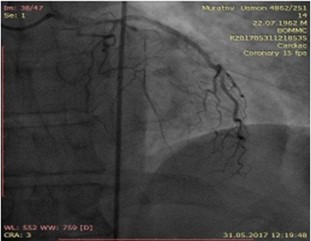
As shown in Figure 1, significant stenosis of the distal third of the left anterior descending artery is clearly demonstrated on coronary angiography. Collateral filling is also visible, highlighting compensatory perfusion pathways that develop in response to the obstructive lesion.
Perioperative and early postoperative outcomes following MIDCAB procedures are summarized in Table 3. Overall, the cohort demonstrated a low incidence of major cardiac and renal complications, while respiratory events and neurological complications were more frequently observed. These results reflect the relative safety of the minimally invasive approach in a patient population with significant baseline comorbidities and highlight areas requiring careful perioperative management.
Table 3: Perioperative and early postoperative outcomes of MIDCAB operations (n=344).
| Parameters |
n |
% |
| Perioperative myocardial infarction |
0 |
0 |
| Acute heart failure |
7 |
2 |
| Respiratory failure |
79 |
23 |
| Encephalopathy |
38 |
11 |
| Heart rhythm disturbances |
31 |
9 |
| Acute renal failure |
0 |
0 |
| Total |
344 |
100 |
Notes: MIDCAB: Minimally Invasive Direct Coronary Artery Bypass; MI: Myocardial Infarction.
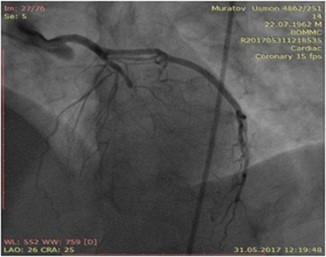
The presence of an occlusive lesion was also observed, specifically in the proximal third of the left anterior descending artery (Figure 2).
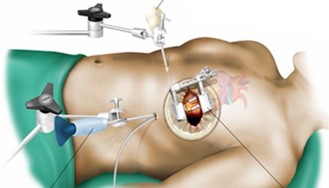
Figure 3 schematically illustrates the preparation and harvesting of the left internal mammary artery (LIMA) for use in MIDCAB procedures.
The duration of MIDCAB procedures ranged from 2 hours 50 minutes (170 minutes) to 3 hours 30 minutes (210 minutes), with a mean operative time of 3 hours 15 minutes (195 minutes).
Perioperative and early postoperative results of MIDCAB
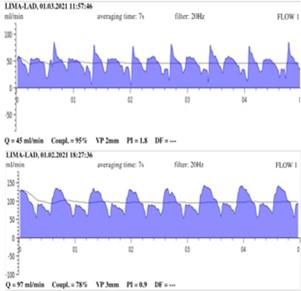
Intraoperative flowmetry assessment was performed to evaluate graft function and hemodynamic performance during MIDCAB procedures. As summarized in Table 4, the measurements provided insights into volumetric blood flow, vascular resistance, and diastolic filling, reflecting the quality of graft anastomosis and the adequacy of myocardial perfusion throughout the intervention.
Table 4: Intraoperative flowmetry parameters.
| Parameter |
Mean ± SD |
| Q (Volumetric Blood Flow), ml/min |
98.6 ± 29.6 |
| PI (Resistance Index) |
2.4 ± 0.9 |
| DF (Diastolic Filling), % |
73.4 ± 7.6 |
Notes: Q: Volumetric blood flow through the graft; PI: Pulsatility (resistance) index reflecting vascular resistance; DF: Diastolic filling percentage indicating the proportion of blood flow during diastole.
Complications commonly associated with cardiopulmonary bypass occur markedly less frequently in patients undergoing MIDCAB. These findings further highlight the clinical advantage of minimizing surgical invasiveness and operative trauma, particularly in high-risk patients, where even minor deterioration in organ function can have significant consequences.
In the present study, MIDCAB proved to be a safe and effective technique for myocardial revascularization and may be considered the preferred approach in carefully selected patient populations. This includes patients in whom the reduction of surgical trauma is essential, as well as those with isolated coronary artery lesions and preserved or mildly impaired myocardial function. In such cases, MIDCAB offers faster postoperative recovery, lower complication rates, and a reduced need for repeat interventions, combining both clinical efficacy and economic advantages.
Taken together with the structural, functional, and perioperative data presented in Tables 1-4 and Figures 1-3, these results reinforce the role of MIDCAB as a reliable minimally invasive alternative to conventional CABG, particularly for patients with significant comorbidities or those at elevated surgical risk.
Discussion
Minimally Invasive Direct Coronary Artery Bypass (MIDCAB) has emerged as a valuable alternative to conventional sternotomy CABG for the treatment of isolated Left Anterior Descending (LAD) artery disease. Contemporary guidelines recognize CABG as the gold standard for myocardial revascularization, particularly in patients with complex coronary anatomy, diabetes, or multi-vessel disease [1,8]. However, there is a clear trend in modern cardiac surgery toward less invasive techniques, aiming to reduce surgical trauma, systemic inflammatory response, and perioperative complications while maintaining long-term graft patency and clinical efficacy [1,4,5].
Several studies have demonstrated the benefits of MIDCAB over conventional CABG and percutaneous coronary intervention (PCI). Meta-analyses and propensity-matched comparisons show that MIDCAB is associated with lower rates of perioperative morbidity, including pulmonary infections, respiratory dysfunction, arrhythmias, and thromboembolic events, which are commonly linked to cardiopulmonary bypass [2,4,13,14]. Moreover, MIDCAB preserves myocardial function by avoiding cardioplegia and maintaining a beating-heart approach, which may be particularly advantageous in elderly or high-risk patients [6,7]. Our cohort exhibited a similar profile, with low incidence of perioperative myocardial infarction or acute renal failure, while respiratory and neurological complications were the most frequent adverse events (Table 3).
The clinical efficacy of MIDCAB is further supported by long-term outcome data. Several single-center studies report comparable or superior graft patency and survival rates relative to drug-eluting stents in isolated proximal LAD disease [3,5,18]. Notably, Benedetto et al. and Etienne et al. demonstrated improved late survival and reduced repeat revascularization rates in MIDCAB patients compared with PCI, confirming the durability of this approach [3,5]. On the other hand, the technical complexity of MIDCAB, limited surgical exposure, and the need for specialized instruments have been cited as barriers to widespread adoption, and outcomes are highly dependent on surgical expertise [10-13].
Comparisons between MIDCAB and full sternotomy off-pump CABG (OPCAB) also highlight advantages and limitations. While both approaches avoid cardiopulmonary bypass and reduce systemic inflammatory response, MIDCAB offers smaller incisions, reduced bleeding, shorter hospital stay, and faster recovery, but may be limited to single- or selected double-vessel revascularization [4,14,15]. In contrast, conventional OPCAB allows complete multi-vessel revascularization but at the expense of larger surgical trauma and longer recovery [16,17]. Thus, patient selection remains critical, favoring MIDCAB for isolated LAD lesions, patients with elevated operative risk, or those prioritizing minimal invasiveness and cosmetic outcomes [9,10,13].
Our instrumental and clinical data reinforce these observations. The cohort exhibited significant left ventricular structural remodeling and reduced systolic function (Table 2), underscoring the importance of precise graft assessment and flowmetry (Table 4) to ensure adequate myocardial perfusion. Coronary angiography confirmed severe proximal and distal LAD stenosis in all patients (Figures 1,2), while the preparation of the left internal mammary artery (Figure 3) allowed safe and effective off-pump revascularization. Perioperative outcomes demonstrated low rates of major cardiac and renal complications, consistent with prior reports [6,11,14].
In summary, MIDCAB represents a safe, reproducible, and clinically effective technique for myocardial revascularization in selected patient populations. Its benefits include reduced perioperative morbidity, faster recovery, and durable long-term outcomes when compared with PCI and conventional CABG, particularly in isolated LAD disease [2,3,5,7,18]. Limitations remain related to technical complexity and restricted applicability in multi-vessel disease, emphasizing the importance of surgeon experience and careful patient selection. Overall, the accumulated evidence supports MIDCAB as a valuable component of the modern minimally invasive coronary surgery armamentarium.
Conclusion
In conclusion, MIDCAB represents a safe and effective approach for myocardial revascularization in patients with isolated left anterior descending artery lesions, including those with significant comorbidities. The technique minimizes surgical trauma, reduces perioperative complications, and supports faster postoperative recovery compared with conventional CABG. Instrumental and clinical data demonstrate preserved graft function, adequate myocardial perfusion, and low incidence of major adverse events. These findings confirm that MIDCAB is a reliable and clinically advantageous option for selected patient populations, offering both safety and efficiency in modern coronary surgery.
References
- Windecker S, Kolh P, Alfonso F, Collet JP, Cremer J, et al. 2014 ESC/EACTS guidelines on myocardial revascularization. Eur Heart J. 2014; 35: 2541-2619.
- Deppe AC, Liakopoulos OJ, Kuhn EW, Slottosch I, et al. Minimally invasive direct coronary bypass grafting versus percutaneous coronary intervention for single-vessel disease: a meta-analysis of 2885 patients. Eur J Cardiothorac Surg. 2014; 47: 397-406.
- Benedetto U, Raja SG, Soliman RF, Albanese A, Jothidasan A, et al. Minimally invasive direct coronary artery bypass improves late survival compared with drug-eluting stents in isolated proximal left anterior descending artery disease: a 10-year follow-up, single-center, propensity score analysis. J Thorac Cardiovasc Surg. 2014; 148: 1316-1322.
- Birla R, Patel P, Aresu G, Asimakopoulos G. Minimally invasive direct coronary artery bypass versus off-pump coronary surgery through sternotomy. Ann R Coll Surg Engl. 2013; 95: 481-485.
- Etienne PY, D’Hoore W, Papadatos S, Mairy Y, El Khoury G, et al. Five-year follow-up of drug-eluting stent implantation vs minimally invasive direct coronary artery bypass for left anterior descending artery disease: a propensity score analysis. Eur J Cardiothorac Surg. 2013; 44: 884-890.
- Hoffmann G, Friedrich C, Barrabas M, Petzina R, Haneya A, et al. Short- and long-term follow-up after minimally invasive direct coronary artery bypass in octogenarians. Interact Cardiovasc Thorac Surg. 2016; 23: 377-382.
- Gunn J, Kuttila K, Vasques F, Virtanen R, Lahti A, et al. Comparison of results of coronary artery bypass grafting versus percutaneous coronary intervention in octogenarians. Am J Cardiol. 2012; 110: 1125-1129.
- Kolh P, Windecker S, Alfonso F, Collet JP, Cremer J, et al. 2014 ESC/EACTS guidelines on myocardial revascularization. Eur J Cardiothorac Surg. 2014; 46: 517-592.
- Zhang L, Cui Z, Song Z, Yang H, Fu Y, et al. Minimally invasive direct coronary artery bypass for left anterior descending artery revascularization: analysis of 300 cases. Wideochir Inne Tech Maloinwazyjne. 2015; 10: 548-554.
- Manca F, Manca M, Muretti M, Portoghese M. Off-pump minimally invasive direct coronary artery bypass in patients with cosmetic prosthesis for pectus excavatum. Interact Cardiovasc Thorac Surg. 2016; 23: 332-334.
- McGinn JT, Shariff MA, Nabagiez JP, Carluchi R, Sadel S, et al. Minimally invasive CABG is safe and reproducible: report on the first thousand cases. Innovations (Phila). 2014; 9: 158-165.
- Nakagawa H, Nabuchi A, Terada H, Hiranuma S, Miyazaki T, et al. Minimally invasive direct coronary artery bypass surgery with right gastroepiploic artery for redo patients. Ann Thorac Cardiovasc Surg. 2015; 21: 378-381.
- Raffa GM, Malvindi PG, Ornaghi D. Minimally invasive direct coronary artery bypass in the era of percutaneous coronary intervention. J Cardiovasc Med (Hagerstown). 2013; 16: 118-124.
- Raja SG, Benedetto U, Alkizwini E, Gupta S, Amrani M. Propensity score adjusted comparison of MIDCAB versus full sternotomy left anterior descending artery revascularization. Innovations (Phila). 2015; 10: 174-178.
- Diana R, Hemelrijck M, Jovana P, Tolboom H, Holubec T, et al. Mid-term outcomes of minimally invasive direct coronary artery bypass grafting. Thorac Cardiovasc Surg. 2015; 63: 313-318.
- Sa MP, Ferraz PE, Escobar RR, Martins WN, Lustosa PC, et al. Off-pump versus on-pump coronary artery bypass surgery: meta-analysis and meta-regression of 13,524 patients from randomized trials. Rev Bras Cir Cardiovasc. 2013; 27: 631-641.
- Soylu E, Harling L, Ashrafian H. A systematic review of the safety and efficacy of distal coronary artery anastomotic devices in MIDCAB and OPCAB surgery. Perfusion. 2015; 31: 537-543.